Hot Strip Sensors

Hot Strip Sensors
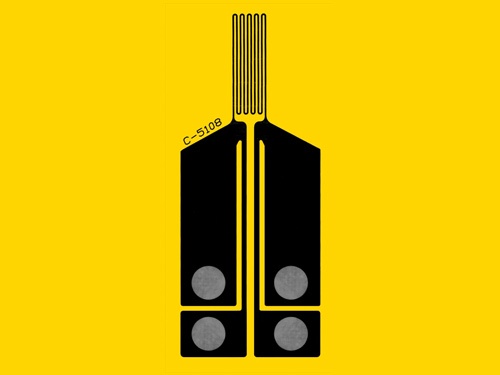
Our patented Hot Strip® sensors are used for testing Thermal Conductivity and Thermal Diffusivity, just like our Hot Disk® sensors. The types complement each other by further extending flexibility and adding new capabilities to our testing range. The design and basic function of the Hot Strip® sensor is identical to that of the Hot Disk® sensor, save that the Nickel foil is patterned in the form of vertical lines instead of shaping into a double spiral. Currently, the Hot Strip® sensor comes in Kapton cladding, and can operate up to 300°C (400°C in vacuum or oxygen-free environment). It comes in widths and lengths ranging from 6.4 to 16 mm and 19 to 59 mm, respectively. Similarly to the Hot Disk® sensors the Hot Strip® sensors are available either with or without cable appendages, whereby the same cable-cladding options are offered.
For More Details..While our Hot Disk® sensors can accommodate most measurement scenarios, our Hot Strip® sensors can importantly tackle odd-shaped and/or limited-sized samples, e.g. rectangular slabs and rods with rectangular or square cross-sections. Regarding anisotropic samples, Hot Strip® sensors can be used to analyse the 3D Thermal Conductivity and Thermal Diffusivity tensors of biaxial materials, whereas the Hot Disk® sensors are limited to analyse the 2D Thermal Conductivity and Thermal Diffusivity tensors of uniaxial materials.
Our range of Kapton-insulated Hot Strip® sensors for Isotropic, Anisotropic, Slab, One-dimensional and Structural Probe measurements, with an operating temperature from -253°C (20 K) up to 300°C (400°C in vacuum or oxygen-free environment), is listed in the following table, followed by images and detailed dimensions:
| Sensor model: | Width (mm) x Length (mm): |
| 5108 | 6.4 x 20.0 |
| 101474 | 16.0 x 19.0 |
| 101472 | 16.0 x 59.0 |
All Kapton-insulated Hot Strip® sensors can be acquired with or without attached cables. The standard polymer-clad cables can be used in a temperature range of -20°C to +50°C while silicone-clad cables are available for use in the wider range of -60°C to +180°C. For cryogenic temperatures, thin-diameter silicone-clad cables are offered. Sensors without cable can be mounted in our sensor interface for high temperatures accessories, for use up to 300°C (400°C in vacuum or oxygen-free environment).
